
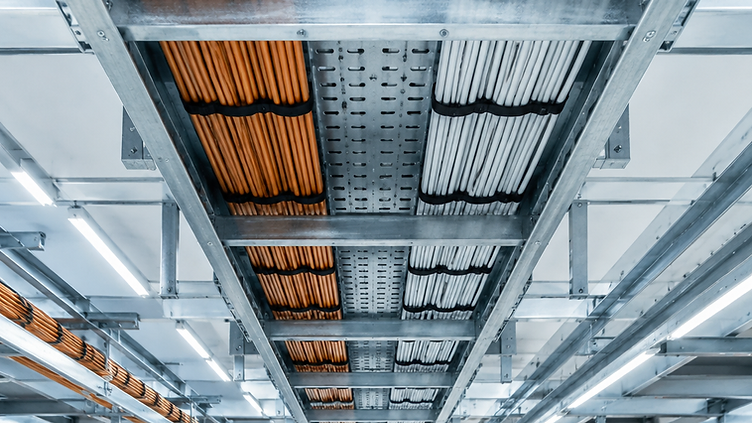
Active equipment is replaced every five years. The cabling, containment and pathways behind it have to serve the building for thirty. That asymmetry is where most adaptation costs are created.
Active equipment has a short life. The building does not.
A network switch is replaced every five to seven years. A wireless access point sooner than that. But the cabling, containment and pathways that connect them are expected to serve the building for thirty years or more, through several generations of equipment that has not been designed yet.
That asymmetry is where most of the cost of adapting a building is created. Not in the equipment, and not in the labour to install it, but in the physical layer's inability to absorb change.
The decisions that age well
Passive infrastructure that stays useful is rarely the result of expensive specification. It is usually the result of a small number of decisions taken early and protected through the programme:
- Spare capacity in the right place. Not blanket over-provisioning, but deliberate spare capacity in the backbones and risers, where adding capacity later is disruptive and expensive.
- Pathways that can be added to. Containment sized for the next ten years of cable, not only for the current drawing.
- Access. Communications rooms and ceiling voids that can be reached, worked in and documented without closing a floor.
- Consistent standards. The same components, the same colour codes, the same labelling throughout, so that work can be carried out by any competent team years later.
Where adaptation costs come from
When a floor is reconfigured, the cost is driven by what has to be opened, re-routed or replaced to reach the new positions. Where containment runs short, where a riser has no spare capacity, or where the documentation no longer matches the building, a routine change becomes a project.
Designing for the second and third fit-out
The question worth asking at design stage is not what the building needs at handover, but what it will need when its occupants change. Buildings that answer that question well share a characteristic: the passive layer is treated as permanent infrastructure, specified and documented to the same standard as the structure it sits in.
That is the discipline behind every project we deliver, and the reason we document as carefully as we install.